 Helix
HelixHow to Validate a Startup Idea: The 2026 Founder's Guide
Abstract
- Validating a startup idea means gathering objective evidence, before you build, that a real problem exists, that a specific group of people wants it solved, and that they'll pay for it.
- The most expensive failure mode in startups isn't building badly; it's building the right thing for the wrong people, or the wrong thing for the right people. Validation surfaces both before you commit.
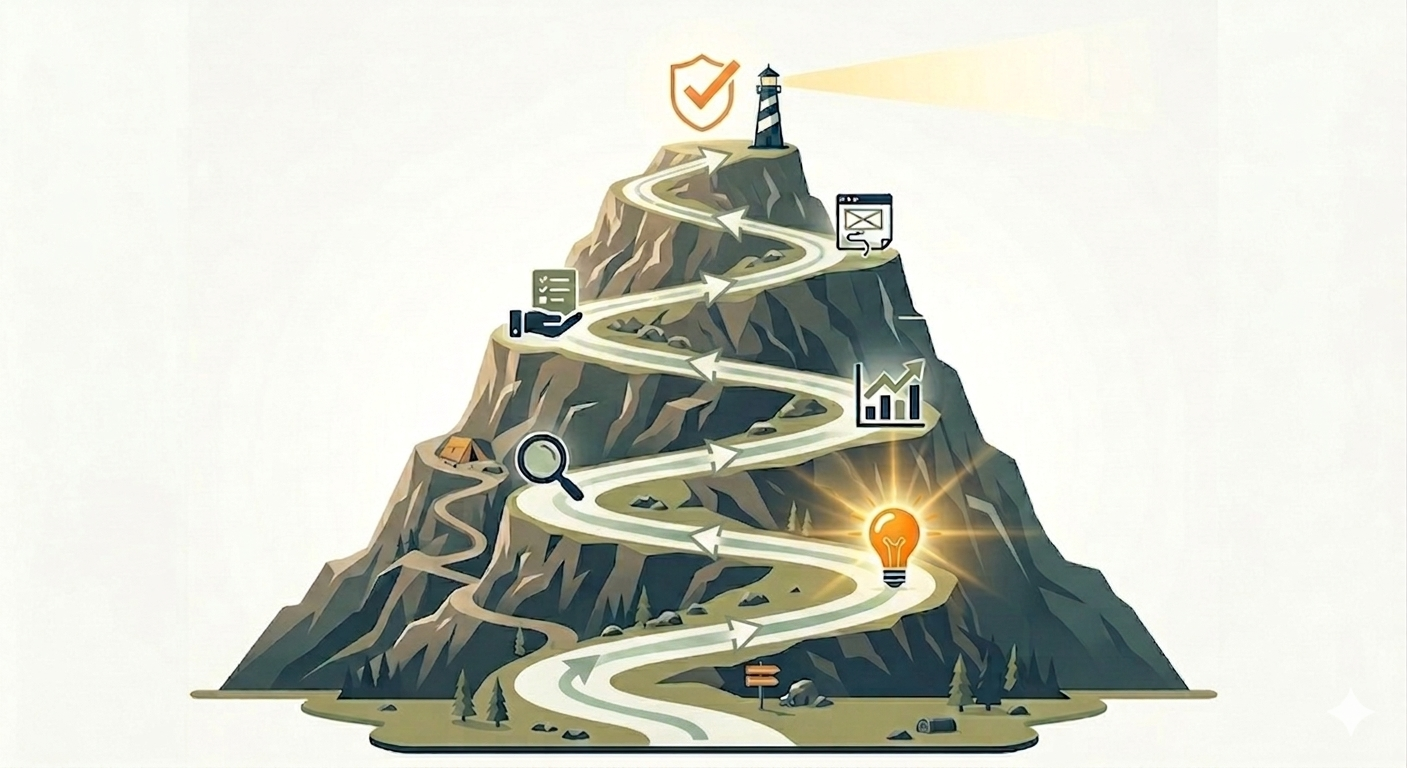
- The 5-step framework: define a falsifiable hypothesis, identify five real users, run problem-interviews using behavior questions (not opinion questions), test willingness-to-pay through engaged waitlist activity or pre-orders, and pressure-test against the market signal.
How to validate a startup idea (and why most founders skip it)
CB Insights' 2024 post-mortem of 110 failed startups identified the single most common cause of failure: 42% died because there was no market need. They built something real, often well-engineered, frequently funded, for a problem nobody actually wanted solved.
This is the validation gap. It's the most expensive mistake in startups, and the easiest to avoid. Learning how to validate a startup idea is a 2-week investment that determines whether the next 6–12 months of building are aimed at a real market or an imagined one.
This guide walks through what validation actually is, the five-step framework that works, and the common patterns that produce false signal. It's written for founders at the earliest stage, anywhere from "I have a vague idea" to "I'm two weeks into building."
What does it mean to validate a startup idea?
Validation is widely misunderstood. Founders often treat it as a confidence-building exercise: collect enough positive signals to feel okay about building. That's the opposite of what it should be.
Validation is the structured attempt to disprove your idea before you build it.
A validated startup idea has objective evidence supporting four claims:
- The problem is real. A specific group of people experiences it consistently, not occasionally.
- The problem is painful enough to act on. They've already tried to solve it, with a tool, a workaround, or a manual process.
- The current solutions are inadequate. The workaround costs them measurable time, money, or frustration.
- They will pay to solve it. Stated intent doesn't count. Behavioral evidence does.
Notice what's not on that list. "People said they liked it." "My friends think it's a great idea." These are not validation. They are politeness, low-commitment curiosity, and confirmation bias.
The bar for validated is high on purpose. The cost of crossing it is two weeks. The cost of skipping it is six months to two years.
Why startup idea validation matters in 2026
Three shifts make validation more important now than at any point in the last decade.
AI made building cheap. A working MVP that took six engineers and a quarter in 2020 takes a single founder and a weekend in 2026. The bottleneck moved upstream. The hardest decision is no longer can we build this. It's should we build this, for whom, and why.
Distribution got harder. Channels that worked five years ago, like content marketing, paid social, and cold outreach, have lower conversion rates and higher costs across nearly every category. A product without product-market fit can no longer be saved by spending more on growth. Validation is the only insurance.
The opportunity cost of being wrong went up. Solo founders and small teams now compete with AI-augmented competitors who can iterate faster. Six months spent building the wrong product is no longer a setback you can recover from with a quick pivot. The market moves while you do.
The 5-step framework to validate a startup idea
Validation is not a single test; it's a sequence. Each step builds on the previous one. Skipping or reordering them produces noise.
Step 1: Write a falsifiable hypothesis
A hypothesis you cannot disprove is not a hypothesis. It's a wish.
Compare these two statements:
- "Founders need a better way to plan startups."
- "Solo, non-technical founders currently spend 4–8 weeks turning a vague idea into a plan their developer or co-founder can act on, and at least 30% give up before they finish."
The second is testable. You can interview 10 people who match that description and find out whether the time estimate is true and whether the abandonment rate is real. The first is unfalsifiable. Every founder "needs" something better.
A good hypothesis specifies who, what, and how much. It should make you slightly nervous because you can imagine being wrong.
Step 2: Identify five real users, not "potential users"
The most common failure in startup validation is interviewing the wrong people. Founders default to friends, fellow founders, and X followers, people who are easy to reach but not representative.
Real users have three properties:
- They currently experience the problem (not "would be interested in" the problem).
- They have agency to solve it (decision-making authority or budget).
- They have no social pressure to be polite to you.
Five is the right number to start. It's enough signal to detect patterns and few enough that you can complete it in a week. Beyond 12–15 interviews, returns diminish sharply, but the first five will move you more than any other research activity.
Where to find them: LinkedIn searches with specific filters, niche subreddit communities, professional Slack groups, customers of adjacent tools (review their G2 profiles), and warm intros through second-degree contacts. Avoid your direct network for the first five. Those interviews are too polluted by relationship dynamics.
Step 3: Run problem-interviews using behavior questions
The single most damaging error in startup validation is asking opinion questions instead of behavior questions.
| Question type | Example | Problem |
|---|---|---|
| Opinion question | "Would you pay for a tool that does X?" | People answer based on what they want to be true |
| Hypothetical | "If we built X, would you use it?" | Costless agreement; no commitment |
| Behavior question | "Walk me through the last time you faced this problem. What did you actually do?" | Forces concrete recollection of real events |
Rob Fitzpatrick's The Mom Test is the canonical reference and worth the four hours to read. The core principle: ask about the user's life and past behavior, not your idea. The user's life is fact; their reaction to your idea is fiction.
A useful five-question script:
- Walk me through the last time you faced [problem area].
- What did you do, step by step?
- What was annoying or costly about that?
- What did you try first, before what you ended up doing? Why did you stop?
- If you waved a magic wand and the problem disappeared, what specifically would change in your week?
Record the calls (with permission). Quote, don't summarize, when you synthesize.
Step 4: Test willingness-to-pay
Stated willingness to pay is meaningless. Behavior is the only signal that matters.
The hierarchy of willingness-to-pay signals, ranked from weakest to strongest:
| Signal | What it actually proves |
|---|---|
| "I'd pay for that" in conversation | Politeness; not validation |
| Cold email signup | Mild curiosity. Useful for top-of-funnel, not for demand. |
| Engaged waitlist signup (replies to follow-ups, answers a screener, books a call) | Real interest. The strongest free signal. |
| Pre-order at full price | Validated demand |
| Letter of intent or signed pilot (B2B) | Procurement-grade interest |
| Active paying user | Validated revenue |
The cheapest credible test is a landing page with a waitlist, followed by a single email asking signups to take one concrete action: book a 15-minute call, answer a 3-question survey, or click through to a pricing preview. Raw signups tell you very little; the signup-to-engagement rate is the real metric. Above 25% engagement is a strong signal; under 10% is a red flag regardless of how positive the interviews were. For founders ready to push harder, a pre-order or paid pilot is the next strongest signal, but engaged waitlist activity is enough to move forward.
Step 5: Pressure-test against the market signal
Before committing, zoom out. Real demand usually shows up in search volume. Confirm people actually search for the problem in language matching your hypothesis (Google Keyword Planner is free; Ahrefs and SEMrush are deeper). Look at adjacent solutions: if five companies tried this and quietly shut down, that's information. If five are growing, that's different information. "No competitors" almost always means no market. Finally, articulate why-now: what changed in the last 24 months that makes this idea viable today when it wasn't before. If you can't name it, the timing is probably wrong.
Common mistakes that produce false validation signal
Across hundreds of post-mortems and case studies, the same patterns appear repeatedly:
Asking leading questions. "Wouldn't it be great if there was a tool that solved X?" is not a validation question. It's a sales pitch disguised as research. Reframe to neutral language: "What's the most frustrating part of your current process?"
Confusing engagement with intent. A user who replies enthusiastically to your DMs is engaging. They are not necessarily buying. The two correlate weakly.
Counting interest from the wrong audience. X founders are not your customer unless you're building for X founders. Validate with people whose buying behavior matches your target user, not with the loudest voices in your feed.
Treating one champion as the market. Finding one user who's deeply enthusiastic is helpful, but until you find five who exhibit the same pattern independently, you have an outlier, not a market.
Skipping the disconfirming evidence. The point of validation is to find reasons your idea won't work, not reasons it will. If your validation process produces only positive signals, you ran it wrong.
Tools that support startup idea validation
Validation can be done with a notebook and a phone. Tools speed up specific steps:
- Customer interview research: Calendly + Otter.ai for scheduling and transcription. Notion or a spreadsheet for synthesizing quotes.
- Landing page tests: Carrd, Framer, or Webflow for sub-1-day landing pages with waitlist forms.
- Search volume: Google Keyword Planner (free), Ahrefs Keywords Explorer, SEMrush, or Ubersuggest.
- Structured idea-to-plan workflow: Helix walks founders through this framework in a guided AI conversation, captures interview synthesis, and generates a structured plan and roadmap from validated input. Disclosure: Helix is the product behind this guide.
The tooling matters less than the discipline. A founder running this framework in a Google Doc will outperform one with the best stack who skips Step 4.
Frequently asked questions
How long does it take to validate a startup idea?
A focused validation cycle takes 10–14 days: 2 days to write the hypothesis and identify users, 5–7 days to schedule and run five interviews, 3–4 days to test willingness-to-pay through a landing page and follow-up engagement, 1 day to pressure-test against market signals. Founders who try to compress it below a week typically skip Step 4.
How many customer interviews do I need to validate an idea?
Five is the minimum to detect patterns; 10–15 is the practical maximum before returns diminish. The quality of the interviewees matters more than the count. Five interviews with the right users beat 30 with the wrong audience.
Can I validate a startup idea without writing code?
Yes, and you should. A landing page with a waitlist, paid pilot commitments, or a manual concierge service (where you deliver the value by hand to early users) produces stronger validation signal than a working MVP. Code locks you into a solution shape; pre-code validation keeps the solution flexible.
How do I validate a B2B startup idea?
The framework applies, with two adjustments: target buyers and budget owners (not end-users) for willingness-to-pay testing, and treat a signed letter of intent or paid pilot as the equivalent of strong demand signal. B2B validation cycles run 4–8 weeks rather than 2, due to procurement timelines.
What if my startup idea is in a niche with low search volume?
Low search volume can indicate either an undiscovered niche or a problem that doesn't exist. Distinguish between them by checking adjacent search terms. If no related queries have volume either, the problem may not be live. If related queries have volume but the specific framing doesn't, you may be using insider language; reframe and re-test.
How do I know my startup idea is validated?
A validated startup idea has objective evidence at three levels: at least 4 of 5 problem-interviews independently confirmed the problem and workaround pattern, at least 25% of waitlist signups engaged with a follow-up ask (call, survey, or pricing-page click), and the market signal (search volume, competitor activity, why-now) supports the timing. Falling short on any of these is information, not necessarily a kill signal, but a flag for further work.
What to do this week
Three concrete steps, in order:
- Write your hypothesis as a falsifiable sentence. If you can't make it specific enough to be wrong, the work is in the specificity, not in the testing.
- Identify five real users by name and book interviews with three of them this week. The biggest predictor of which founders ship is whether they ran the first three interviews within a week of deciding to.
- Build a one-page landing page with a waitlist, then write the follow-up email asking signups to take one concrete action: a call, a survey, or a click through to pricing.
If you want a structured environment to run this framework (guided interviews, synthesized findings, and a generated plan from the validated input), Helix was built for exactly this loop. The framework above stands regardless of tooling.